Yoga for Beginners: What Nobody Tells You in the First Month
Most people who quit yoga do not quit because it was too hard. They quit because they expected the wrong things from it, judged themselves against a photograph, and concluded after two weeks that it was not working.
This guide is the honest version of a first month: what changes early, what takes far longer, and what you can safely ignore for now.
What yoga actually is, stripped of the marketing#
For a beginner, yoga is three things happening at once: you move a joint through its range, you hold a shape long enough for the supporting muscles to notice, and you keep breathing evenly while doing both. The philosophy, the Sanskrit and the styles all sit on top of that. None of them are required on day one.
- Movement: taking the spine, hips, shoulders and ankles through directions a desk-bound day never asks for.
- Holding: staying in a shape for five slow breaths, which is where the strength part quietly happens.
- Breathing: a steady nasal breath, which is the single most reliable signal that you are working at the right intensity.
- Attention: noticing what your body is doing, which is what separates yoga from stretching in front of the television.
If you can breathe evenly in a pose, you are in the right version of it. If you are holding your breath, you have gone too far — regardless of how the pose is supposed to look.
Week by week: what a realistic first month looks like#
| When | What you notice | What it means |
|---|---|---|
| Days 1 to 3 | Wobbling, forgetting the sequence, sore in odd places | Normal. Your nervous system is learning shapes it has never made |
| Week 1 | Sleep improves, you feel calmer after practice | Breathing and the parasympathetic response — the fastest benefit |
| Week 2 | Poses feel familiar, less mental effort to follow along | Motor learning. This is the week most people quit, and the week it starts working |
| Week 3 | Slightly more range: hands lower in a forward fold | Real tissue and nervous-system change beginning |
| Week 4 | You notice you sit up straighter without deciding to | Postural awareness carrying over into the rest of the day |
Nothing in that table is a photograph of a difficult pose. That is deliberate: visible flexibility milestones arrive in months two to six, not in month one.
The five expectations that make beginners quit#
- Expecting flexibility to arrive first. It arrives last. Calm, sleep and body awareness arrive first.
- Comparing yourself to the instructor in a video, who has done this for a decade and is built differently.
- Assuming a longer session is a better session. Twenty minutes three times a week beats ninety minutes once.
- Treating modifications as failure. A bent knee or a block under the hand is the pose, not a lesser version of it.
- Believing soreness means progress. Muscle soreness is fine; joint pain, especially in the knees, wrists or lower back, is a signal to change what you are doing.
What you need, and what you can ignore#
The barrier to starting yoga is almost entirely imaginary. Here is the whole list of what actually matters in month one.
- A mat, mostly for grip. Sliding hands in downward dog is the most common cause of sore wrists.
- Two blocks, or two thick books, which make roughly half the standing poses accessible.
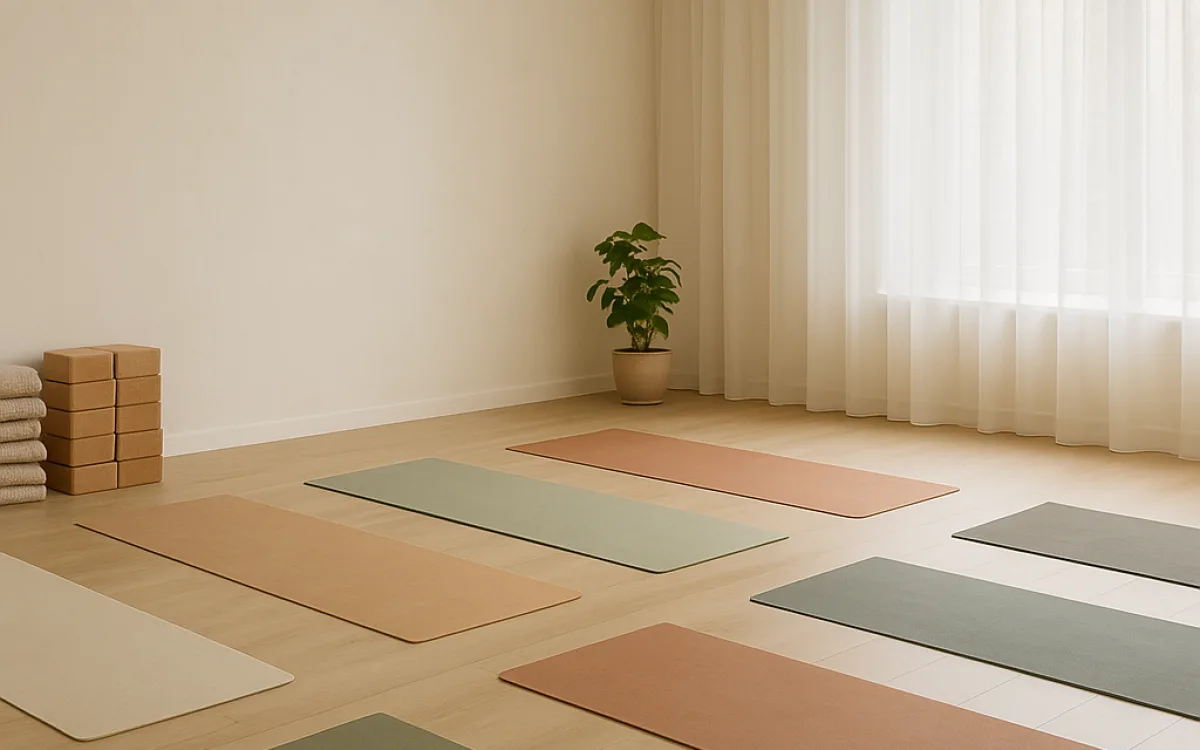
- Enough floor space to lie down with your arms out. That is it.
- Twenty minutes, three times a week, at a time of day you can repeat.
You do not need special clothing, a wheel, an app subscription, a studio membership, or the ability to touch your toes. Every one of those can be decided after eight weeks, when you know what you actually use.
How to tell it is working#
Judge a first month on four signals, none of which is a pose. If three of the four are true at the end of week four, the practice is doing its job and the visible changes will follow.
- You sleep more easily on days you practise than on days you do not.
- You can hold a simple standing pose for five breaths without the breath becoming ragged.
- You notice your own posture during the day, at a desk or in a queue, without being told to.
- You are looking forward to the next session rather than negotiating with yourself about it.
Frequently asked questions
How long does it take to get good at yoga as a beginner?
That depends on what you mean by good. Feeling calmer and sleeping better usually takes one to two weeks. Moving through a beginner sequence without having to think about each step takes four to six weeks. Noticeable flexibility change takes two to three months of regular practice. Being able to do the poses that appear on social media can take years, and for some body types never happens at all — which has no bearing on whether your practice is working.
Is yoga enough exercise on its own?
For general mobility, balance, body awareness and stress it does a great deal, and a vigorous style adds real strength. It is weaker on cardiovascular fitness and on progressive loading for bone density. If yoga is your only movement, adding two brisk walks a week covers most of the gap. If you already train, yoga is usually the thing that keeps you training without injuries.
I am not flexible and not calm. Is yoga really for me?
Those are the two most common reasons people give for not starting, and both describe what yoga is for rather than what it requires. A stiff body has more to gain from mobility work than a flexible one. A busy mind gets more from breath-led movement than a quiet one. The only genuine prerequisites are a floor and twenty minutes.
yoga for beginnershow to start yogafirst month of yogayoga for complete beginnersbeginner yoga guidewhat is yoga