Yoga Safety: How Beginners Actually Get Hurt
Yoga has a good safety record — better than most recreational activities, and considerably better than running. Injuries do happen, and when they do the pattern is consistent enough to be worth knowing.
They are rarely dramatic. Almost all of them are gradual overuse in four specific places.
The four places beginners get hurt#
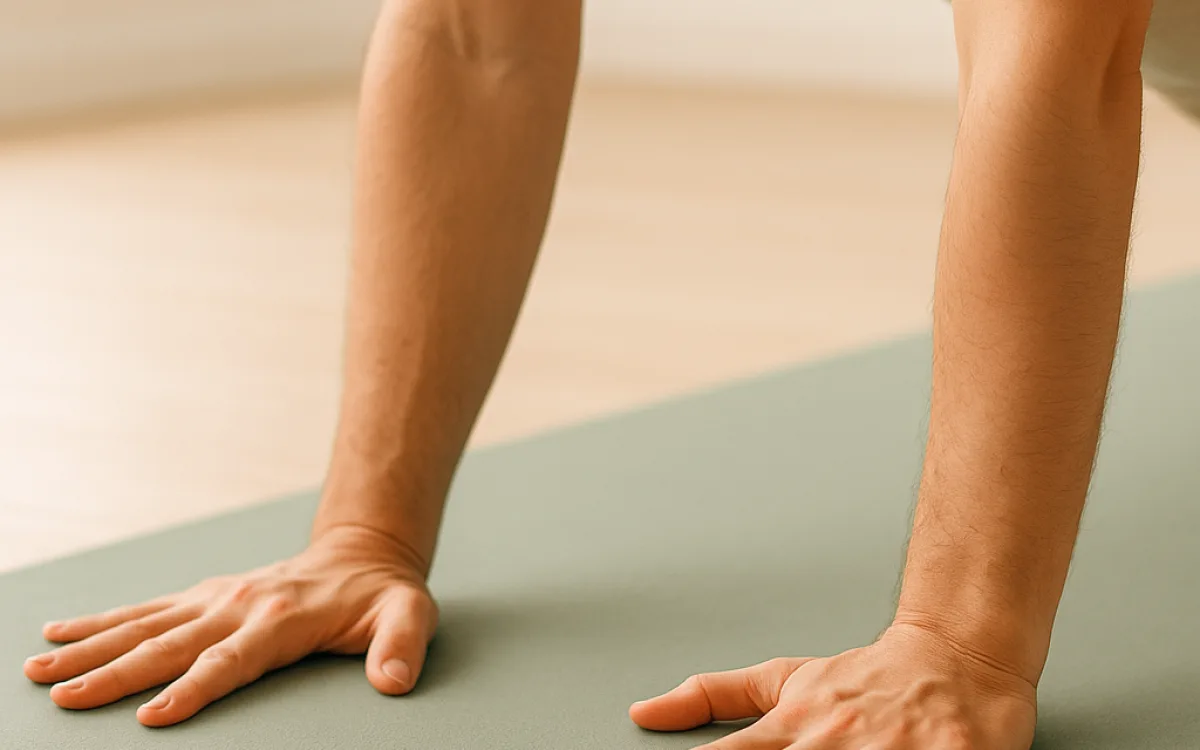
- Wrists. Repeated weight-bearing with the load in the heel of the palm, usually in downward dog, plank and sun salutations. The most common yoga complaint by a wide margin.
- Shoulders. Chaturanga performed repeatedly with the shoulders dropping below the elbows. The classic overuse injury of flowing styles.
- Lower back. Deep forward folds with straight legs and tight hamstrings, and backbends taken beyond what the upper back can contribute.
- Knees. Cross-legged sitting on a hard floor with tight hips, and standing poses where the front knee drifts inwards.
- Hamstring attachment. A dull ache at the sitting bone from repeated aggressive forward folding — slow to appear and notoriously slow to resolve.
Notice that none of these come from difficult poses. They come from ordinary poses repeated many times with a small error in each repetition.
The five rules that prevent nearly all of it#
- If you cannot breathe evenly through the nose, you are too deep. Come out. This one rule prevents most of the list above.
- Never use momentum. Bouncing, jerking or throwing yourself into a shape is where acute injuries come from.
- Take the modification while learning. Knees-down chaturanga, bent knees in every forward fold, blocks under the hands.
- Warm up before anything demanding, especially in the morning and especially in cold weather.
- Do both sides, for the same length of time, every time. Asymmetric practice creates the imbalance you are trying to fix.
Conditions that need advice before you start#
| Condition | Concern | What to do |
|---|---|---|
| Pregnancy | Some poses unsuitable by trimester | Prenatal classes; tell any teacher |
| Recent surgery | Healing tissue and load limits | Medical clearance first, then a small class |
| Disc herniation or sciatica | Loaded spinal flexion can aggravate | Physiotherapy first; avoid deep forward folds |
| Glaucoma or retinal issues | Inversions raise intraocular pressure | Avoid inversions; ask an ophthalmologist |
| Uncontrolled high blood pressure | Inversions and breath retention | Get it managed; avoid holding the breath |
| Osteoporosis | Spinal flexion carries fracture risk | Avoid rounded forward folds and deep twists |
| Hypermobility | End-range holds worsen instability | Strength-focused practice, not yin |
None of these rules out yoga. All of them change which class you should be in, and every one of them is a two-sentence conversation with a teacher.
Hands-on adjustments#
Physical adjustment from a teacher can be genuinely useful and is also a source of injury when a teacher pushes a student past their range. You are entitled to decline, permanently and without explanation.
- Many studios use consent cards or ask at the start of class. If yours does neither, saying no thank you once is enough.
- A good adjustment is light and stabilising. Being pressed deeper into a stretch is not a good adjustment.
- Say something immediately if an adjustment hurts. Teachers cannot feel your joints.
- If you have an injury, tell the teacher before class rather than relying on being asked.
What to do if something hurts#
- Come out of the pose immediately. Do not finish the breath count.
- Rest for the remainder of the session in child pose or lying down.
- Do not stretch it later that day to see if it still hurts. That is the most common way a minor strain becomes a persistent one.
- Leave it three or four days, then test gently. Most minor strains settle in a week.
- See a physiotherapist or doctor if there is any tingling, numbness, weakness, sharp joint pain, or if nothing has changed after a fortnight.
Frequently asked questions
Is yoga safe for beginners?
Yes, with a better injury rate than most recreational activity. The injuries that do occur are overwhelmingly gradual overuse rather than dramatic accidents, and they concentrate in the wrists, shoulders, lower back and knees. Practising within a range where you can breathe evenly, taking modifications while learning, and avoiding momentum removes most of the risk.
What are the most common yoga injuries?
Wrist strain from weight-bearing with the load in the heel of the palm, shoulder problems from repeated chaturanga, lower back irritation from deep forward folds with straight legs, knee pain from cross-legged sitting and poorly aligned standing poses, and hamstring attachment strain from aggressive forward folding. All five are overuse injuries built up over weeks.
Should I tell my yoga teacher about an injury?
Yes, always, and before class rather than after. It takes fifteen seconds, it is completely routine, and it lets the teacher offer you an alternative before the pose arrives instead of watching you struggle through it. The same applies to pregnancy, recent surgery, high blood pressure and eye conditions.
yoga safety for beginnerscommon yoga injuriesyoga wrist injuryis yoga safeyoga contraindicationsyoga injury prevention