Restorative Yoga for Beginners: Doing Almost Nothing, Properly
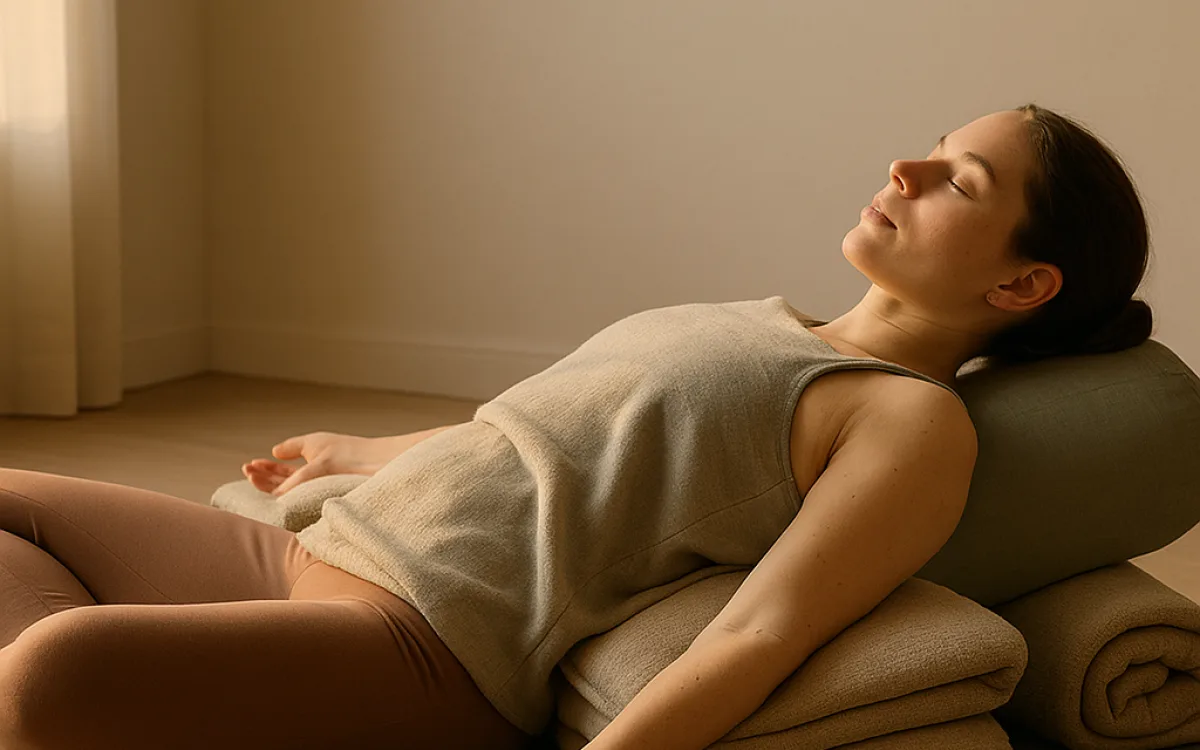
Restorative yoga is the style that is hardest to explain and easiest to do. You lie on a pile of cushions in a shape, supported so completely that nothing in your body has to work, and you stay there for five to fifteen minutes.
There is no stretch. That is not an oversight — it is the entire design.
What it is for#
Restorative practice is aimed at the nervous system rather than at tissue. The goal is to remove every reason for a muscle to hold, so the body can shift out of a low-grade state of readiness that many people live in permanently.
- Complete physical support, so no muscle is required to maintain the shape.
- Long holds, usually five to fifteen minutes per pose, and only four or five poses in a class.
- Warmth: blankets over the body, because temperature drops when you stop moving.
- Darkness and quiet, often with an eye cover.
- Slow breathing, with an emphasis on an unforced, longer exhale.
If you feel a stretch, the pose is not set up correctly. Add another cushion. Beginners consistently under-prop, because a stretch feels like something happening and support feels like cheating.
Who benefits most#
- Anyone in a period of high stress, illness or exhaustion, where a vigorous practice would take rather than give.
- People recovering from injury or surgery, once cleared to lie in supported positions.
- Those with persistent pain, where movement-based practice is limited but nervous-system work is not.
- Anyone with insomnia related to rumination rather than physical discomfort.
- Athletes and hard trainers, who tend to have the least practice at genuinely stopping.
It is also the style that feels least like it is working, which is why people abandon it fastest. Give it three sessions before judging.
Four poses and how to build them from household things#
| Pose | Studio props | Household version |
|---|---|---|
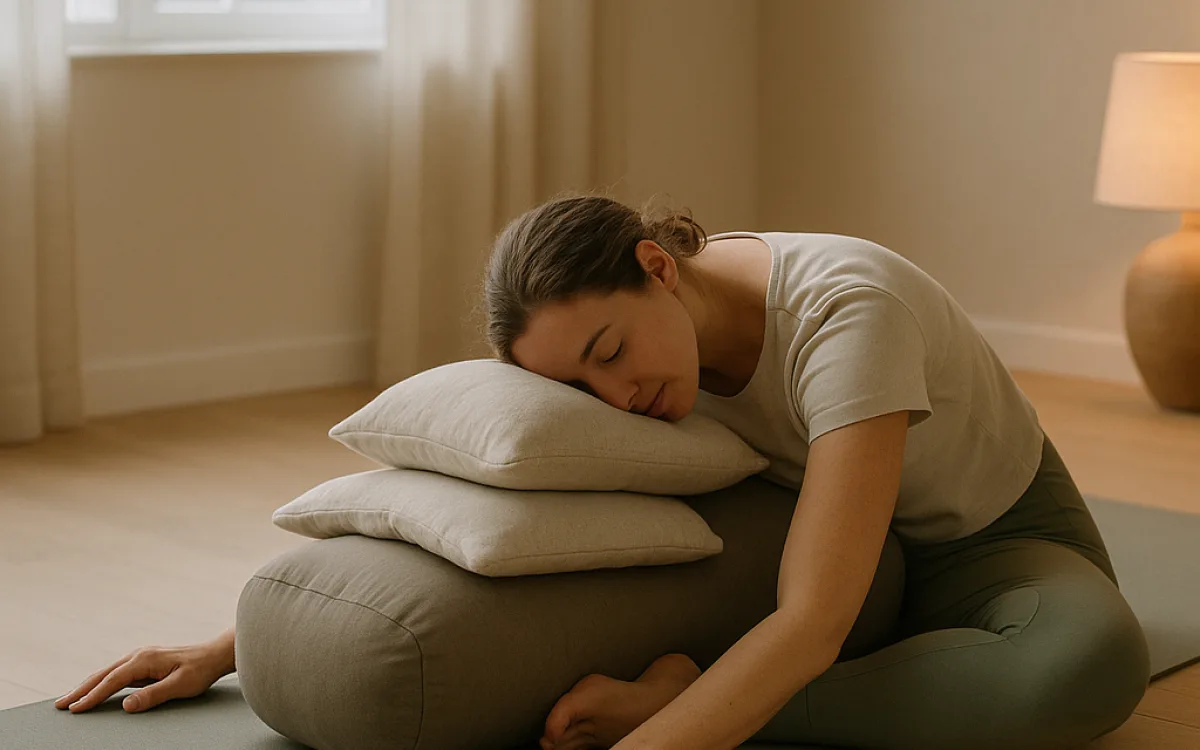
| Supported child pose | Bolster lengthways under the torso | Two bed pillows stacked, plus a folded towel under the ankles |
| Supported reclined bound angle | Bolster along the spine, blocks under the knees | Sofa cushions along the spine, pillows under each thigh |
| Legs up the wall | Folded blanket under the hips | A folded duvet, or legs on a chair seat instead of the wall |
| Supported side-lying rest | Bolster between the knees, blanket under the head | Pillow between the knees, another under the head |
| Savasana with support | Rolled blanket under the knees, eye pillow | Cushion under the knees, a folded scarf over the eyes |
How to run a session at home#
- Choose two or three poses, not five. A short, well-supported session beats a long, fidgety one.
- Set everything up before you begin, including the blanket and a timer, so you are not getting up mid-pose.
- Set the timer for five minutes per pose to start; build to ten as you get more comfortable staying still.
- Do less than you think in the transitions — move slowly and re-prop rather than rushing between shapes.
- Finish lying flat for five minutes and get up slowly. Standing up quickly from a restorative practice is genuinely disorienting.
Restorative, yin and gentle yoga are not the same thing#
These three get used interchangeably on timetables and mean quite different things. Gentle yoga is ordinary yoga at a low intensity — you still move and still hold poses actively. Yin is passive but seeks a moderate stretch sensation for three to five minutes. Restorative seeks no sensation at all and supports everything. If you book a class expecting one and get another, the difference is obvious within the first ten minutes.
Frequently asked questions
What is restorative yoga good for?
Stress, exhaustion, recovery from illness or injury, persistent pain, and insomnia driven by a busy mind. It works on the nervous system rather than on flexibility or strength, so it produces none of the usual markers of progress — which is why it feels like nothing is happening while being one of the more useful things available during a hard period.
Do I need a bolster for restorative yoga?
No. Everything a bolster does can be done with bed pillows, sofa cushions, a rolled duvet and a couple of folded towels. Being generously supported matters; the equipment does not. If you practise restoratively every week for a few months, a bolster is a reasonable purchase, but nothing in a first year requires one.
How is restorative yoga different from just lying down?
In the specific shapes and in the support. A restorative pose puts the body into a gentle position — a mild opening, a slight twist, legs elevated — and then removes every reason to hold it. The combination of shape plus complete support is what produces the effect, which is why five minutes in supported bound angle feels different from five minutes lying flat.
restorative yoga for beginnerswhat is restorative yogayoga with bolstersupported yoga posesyoga for exhaustionrestorative vs yin