Yin Yoga for Beginners: Long Holds and Why They Work
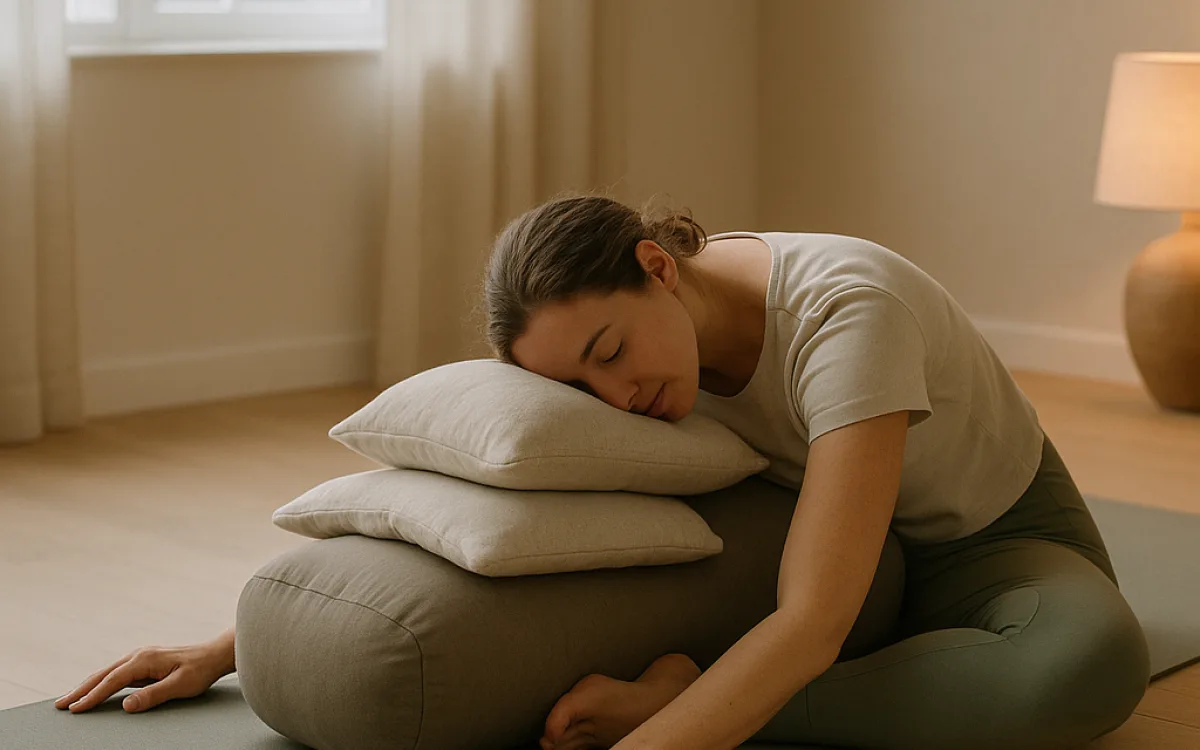
Yin is the style where you settle into a shape, do nothing at all, and stay there for three to five minutes. Beginners often assume that means it is easy. The first two minutes are easy. The rest is where the practice actually is.
It is also the style most often taught badly, because the instruction that makes it safe is a single sentence that classes sometimes skip.
What yin is trying to do#
Where a muscular stretch is held for thirty seconds, yin holds a relaxed shape for minutes, targeting connective tissue — fascia, ligaments and joint capsules — which responds to sustained, low-intensity load rather than to short intense ones.
- Long holds of two to five minutes, occasionally longer.
- Muscles deliberately relaxed rather than engaged, which is the opposite of most yoga.
- Poses done sitting or lying, heavily supported with cushions and blocks.
- Focus mainly on hips, pelvis, lower spine and the backs of the legs.
- Stillness, which is also the mental practice — there is nothing to do but notice.
The sensation should be moderate and spread, at around a five out of ten, and it should not increase during the hold. If it grows, come out slightly. This is the sentence classes sometimes skip.
The two safety rules#
- Never go to your maximum range. Yin works at roughly sixty to seventy per cent of what you could reach, because you are holding it for minutes rather than seconds. A shape that is fine at thirty seconds can be too much at three minutes.
- Come out slowly and gently. Tissue held for several minutes needs a moment before it is loaded again — moving straight into a standing pose after a long hold is how people tweak a knee or a hamstring.
- Support the shape so no muscle has to hold you there. If you are working to stay in the pose, it is not yin.
- Never hold a shape that produces sharp, pinching or radiating sensation, particularly around the knees.
Who yin suits, and who it does not#
| Suits | Because | Less suitable |
|---|---|---|
| Stiff, desk-bound bodies | Long holds target exactly the hips and lower back that sitting shortens | People who are already very flexible or hypermobile |
| Stressed or busy minds | Stillness is the practice; it is a mindfulness class with a shape | People who find stillness distressing rather than difficult |
| Athletes and runners | Complements loading work; targets tissue that training tightens | Anyone with an acute joint injury |
| Evening practice | Settling rather than stimulating | Morning practice — a cold body should not be held at end range |
If you are hypermobile — your joints move further than most people and you have always been bendy — long passive end-range holds are usually the wrong practice. Strength work suits you far better, and a teacher should be told.
Five poses that make up most yin classes#
- Butterfly: sitting, soles of the feet together and away from the body, folding forward onto cushions.
- Dragon: a deep lunge with the back knee down on padding, hands on blocks.
- Sphinx: lying on the front, propped on the forearms, for the lower back.
- Caterpillar: a seated forward fold with a deliberately rounded back and no effort at all.
- Reclined twist: knees dropped to one side onto a cushion, held for several minutes.
Names vary between teachers, and yin poses have their own vocabulary distinct from other styles. Nothing is lost if you never learn any of them.
What to expect in your first class#
Physically, easier than you expect and mentally harder. The first minute is comfortable, the second is fine, and somewhere in the third the mind starts negotiating. That is the practice, not a sign you are doing it wrong. Bring an extra layer, because you cool down considerably when you stop moving, and expect to feel unusually loose and slightly spacey for an hour afterwards — which is why yin sits so well in the evening.
Frequently asked questions
Is yin yoga good for beginners?
Yes, and it is one of the more accessible starting points for stiff or older bodies, because nothing requires strength, balance or coordination. What it does not teach is alignment or how the standing poses work, so it is best paired with a hatha class rather than used as your only practice. Complete beginners should tell the teacher, mainly so they can check the knee positioning in the deeper hip shapes.
How long do you hold poses in yin yoga?
Typically three to five minutes, sometimes up to ten in a slow class. Because the holds are long, you work at around sixty to seventy per cent of your maximum range rather than your limit. A shape that feels fine at thirty seconds can become far too much at three minutes, which is the most common beginner mistake in the style.
What is the difference between yin and restorative yoga?
Yin seeks a moderate stretch sensation in connective tissue and is mildly uncomfortable by design. Restorative seeks no stretch at all — every pose is fully supported so the body can let go completely. Yin is a practice you work at quietly; restorative is closer to supported rest. If long holds feel like too much sensation, restorative is the better choice.
yin yoga for beginnerswhat is yin yogayin vs restorative yogalong hold yoga posesyin yoga hipspassive stretching yoga