How to Start Yoga at Home: A Practical First Week
Starting at home removes the two biggest barriers — cost and self-consciousness — and adds one of its own: nobody is watching, so nothing keeps you honest.
The fix is not motivation. It is making the practice so small and so specific that skipping it takes more effort than doing it.
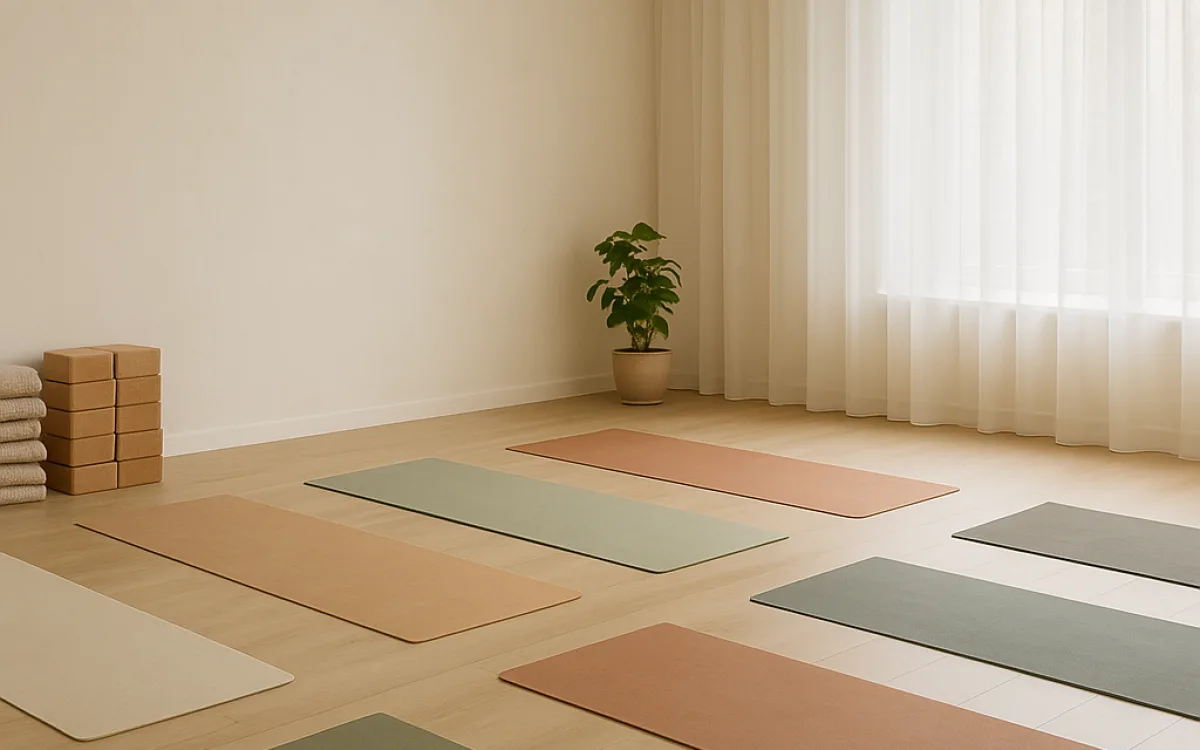
Set up a corner, not a room#
The single strongest predictor of whether a home practice survives week two is how much friction stands between you and the mat. A mat that lives rolled up in a cupboard behind the vacuum cleaner does not get used.
- Choose a spot with enough space to lie down with your arms stretched sideways.
- Leave the mat unrolled if you can, or standing against the wall where you can see it.
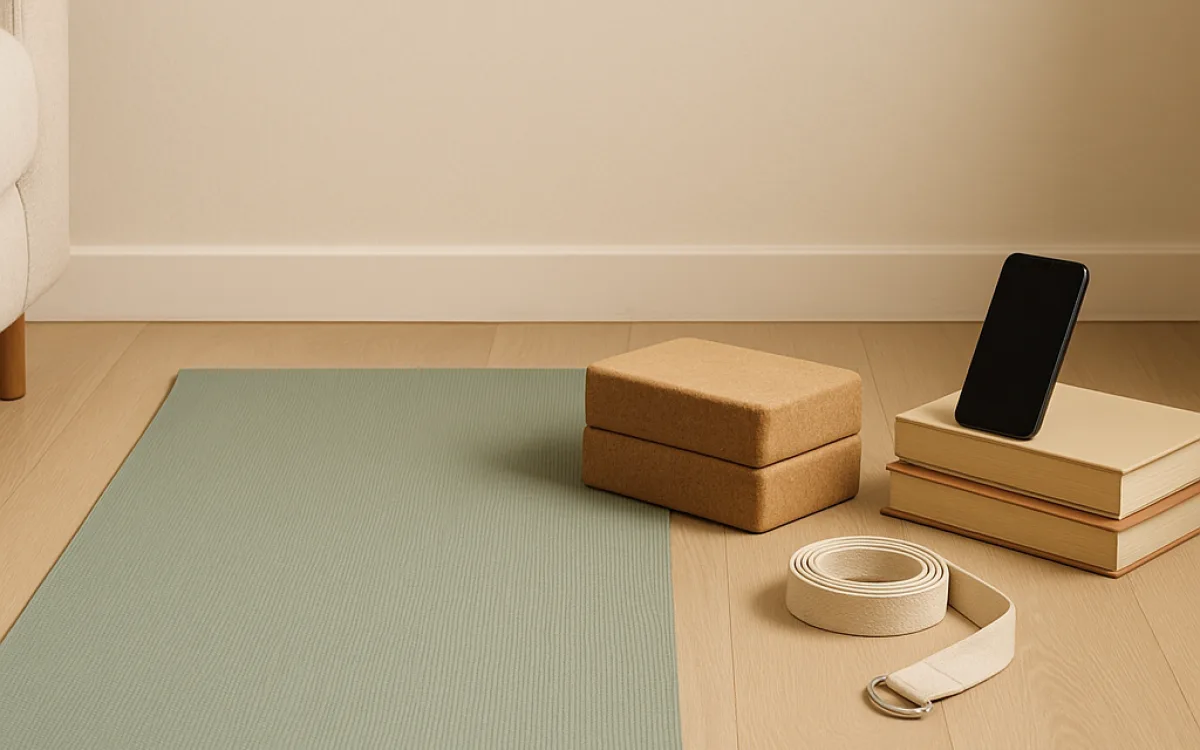
- Keep two blocks or two thick books at the edge of the mat, not in another room.
- Check for a hard floor rather than deep carpet — balance poses on soft carpet teach your ankles the wrong lesson.
- Have somewhere to prop a phone or tablet at roughly eye level when kneeling.
Practising in front of a mirror is optional and, for most beginners, a distraction. Feeling where your weight sits teaches more than watching yourself does.
Your first week, session by session#
| Day | Length | What to do |
|---|---|---|
| Day 1 | 10 minutes | Cat-cow, child pose, a gentle standing forward fold, five minutes lying still |
| Day 2 | Rest | Walk if you like. The point is that day 3 arrives with you not sore |
| Day 3 | 15 minutes | Add downward dog with bent knees, and a low lunge on each side |
| Day 4 | Rest | Notice whether anything aches in a joint rather than a muscle |
| Day 5 | 15 minutes | Repeat day 3 and add warrior II with hands on the hips |
| Day 6 | 10 minutes | A slow, easy repeat of day 1 — this is the day that builds the habit |
| Day 7 | Rest or 20 minutes | Only if you want to. Wanting to is the goal of week one |
Notice how much repetition is in that week. Learning four poses properly is worth more than sampling forty.
Choosing what to follow#
Free video classes are excellent and also the place beginners most often go wrong, because the algorithm rewards energetic sequences rather than appropriate ones.
- Search for beginner classes that are 10 to 20 minutes, not 45. Length is the most common reason a plan dies.
- Prefer a teacher who names the modification before the full pose rather than after it.
- Avoid anything titled as a challenge, a burn, a bootcamp or a countdown to a specific pose.
- Repeat the same class three or four times before moving on. Familiarity is what lets you feel the pose instead of watching the screen.
- Turn the sound down and pause freely. A class is not a race you can fall behind in.
Staying honest without a teacher#
Nobody at home will tell you your hips are twisted or your shoulders are at your ears. These four self-checks catch most of what a teacher would correct in a beginner.
- Breath: if you cannot breathe through your nose evenly, come out a little.
- Shoulders: in any pose with the arms loaded, roll the shoulders down away from the ears once and see whether the pose changes.
- Knees: a knee should never point in a different direction from the foot underneath it.
- Lower back: if your lower back is doing the work in a backbend or a forward fold, bend the knees and shorten the range.
Filming yourself once a month from the side tells you more than a mirror does, and is far less discouraging than watching yourself the whole time.
When to add a real class#
A studio class after six to eight weeks at home is worth the money in a way that a class on day one usually is not: you arrive already knowing the shapes, so the teacher can correct details rather than teach you the alphabet. One class every few weeks, alongside home practice, is a common and sensible pattern.
Frequently asked questions
Can you really learn yoga at home without a teacher?
Yes, for beginner-level practice. Everything in a first three months is within reach of a good video, a mat and some patience. What a teacher adds is correction you cannot see and progression you would not choose. A reasonable middle path is home practice as the routine and an occasional in-person class as the audit.
How much space do I need for home yoga?
Enough to lie down with your arms out to the sides, which is roughly two metres by one. That is the whole requirement. Low ceilings only matter if you plan to do standing poses with the arms overhead, and even then a slight bend in the elbows solves it.
What time of day is best to practise at home?
The time you will actually repeat. Morning practice is stiffer but far more consistent, because fewer things can push it aside. Evening practice moves better and suits winding down, but is the first casualty of a long day. Pick one, keep it for four weeks, then change it if it is not working.
how to start yoga at homehome yoga for beginnersyoga at home without equipmentbeginner yoga routine at homefirst week of yogayoga practice space