Downward Dog for Beginners: Why It Hurts and How to Fix It
Downward dog appears in nearly every class and is the pose beginners most often do badly, because it looks simple and is not. The usual result is aching wrists, a rounded back and the private conviction that yoga is not for you.
Almost all of that comes from one mistake: trying to straighten the legs and put the heels down.
What the pose is actually asking for#
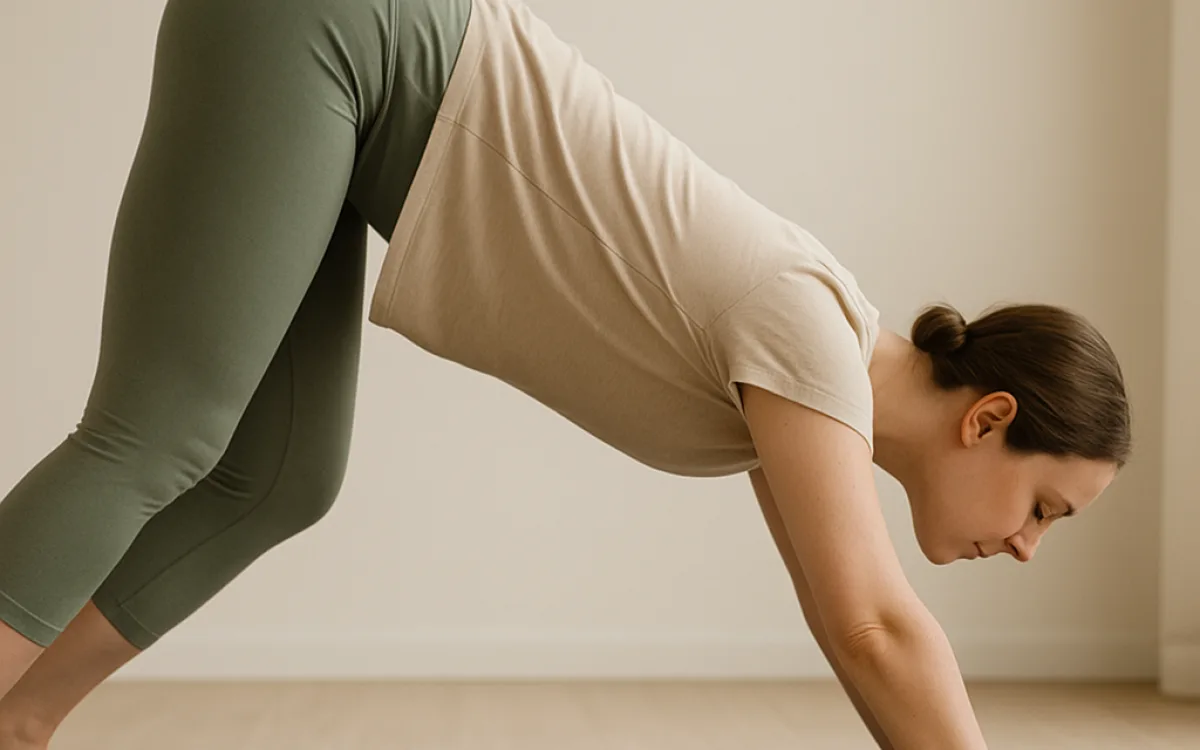
Downward dog is a shoulder and spine pose that happens to involve the legs. The goal is a long line from the hands to the hips. Everything below the hips is negotiable, and for most beginners it should be heavily negotiated.
- A long, straight spine from the wrists to the sitting bones — this is the entire point.
- Hips lifting up and back, as if a rope were pulling them towards the ceiling.
- Weight spread across the whole hand, with the base of the index finger pressing down.
- Knees bent as much as needed. Any amount. Bent knees are not a compromise version.
Straight legs and heels on the floor are a function of hamstring and calf length, not of doing the pose well. Plenty of experienced practitioners never put their heels down.
Step by step, from hands and knees#
- Start on hands and knees. Hands slightly forward of the shoulders, fingers spread wide, middle finger pointing straight ahead.
- Press the whole hand down, especially the knuckle at the base of the index finger, and feel the arms straighten without locking.
- Tuck the toes under and lift the knees just an inch. Pause here — this is already most of the pose.
- Lift the hips up and back with the knees still clearly bent, and let the head hang between the arms.
- Only now, if it does not round your back, begin to straighten the legs a little. Stop the moment the lower back starts to round.
Fixing the four common problems#
| Problem | Cause | Fix |
|---|---|---|
| Wrists ache | Weight in the heel of the palm, wrists at 90 degrees | Spread fingers, press the index knuckle, use blocks or a wedge under the palms |
| Back rounds | Chasing straight legs with tight hamstrings | Bend the knees far more; lift the sitting bones towards the ceiling |
| Shoulders by the ears | Not rotating the upper arms outward | Turn the inner elbows to face each other and draw the shoulder blades towards the hips |
| Feet slide forward | Grippy socks, carpet or a worn mat | Practise barefoot on a mat with real grip; slipping is a genuine injury risk |
| Heels will not reach the floor | Normal calf and hamstring length | Ignore it entirely. It is not a goal |
If your wrists still hurt#
Wrist pain in downward dog is common, fixable and worth taking seriously, because it is one of the few yoga complaints that can become persistent.
- Use two blocks under the hands at their lowest setting, which reduces the wrist angle noticeably.
- Try dolphin pose — the same shape on the forearms — which removes the wrists from the equation altogether.
- Do the pose against a wall: hands on the wall at hip height, walk the feet back until the body forms an L. Same shape, a fraction of the load.
- Spend less time in it. Three breaths done well beats ten breaths grinding your wrists.
Wrist pain that persists between sessions, or tingling in the fingers, is worth a medical opinion rather than another modification.
How to know you are doing it right#
Forget the mirror. Four internal signals tell you more than any photograph.
- You can breathe evenly through the nose for five breaths.
- Your weight feels shared between hands and feet rather than dumped into the hands.
- Your back feels long, not rounded, even if your knees are deeply bent.
- When you come out, your shoulders feel worked and your wrists feel neutral.
Frequently asked questions
Why does downward dog hurt my wrists?
Almost always because the weight is sitting in the heel of the palm rather than spread across the whole hand, which forces the wrist into a sharp angle under load. Spread the fingers wide, press down through the knuckle at the base of the index finger, and turn the inner elbows towards each other. If it still hurts, put blocks under the hands or practise dolphin pose on the forearms instead.
Should my heels touch the floor in downward dog?
No, and this is the single most damaging misconception about the pose. Heel position depends on calf and hamstring length and has no relationship to how well you are doing it. Trying to force the heels down usually rounds the back, which is the one thing that genuinely makes the pose worse. Bend the knees and let the heels float.
How long should a beginner hold downward dog?
Three to five breaths, coming down to hands and knees between repetitions. It is a demanding pose for the shoulders and wrists, and beginners get much more from three good repetitions than from one long hold with deteriorating form. Build to longer holds over a few months rather than weeks.
downward dog for beginnersdownward facing dogwrist pain yogaadho mukha svanasana beginnerdownward dog modificationsyoga heels down