Warrior Poses for Beginners: I, II and the Knee Problem
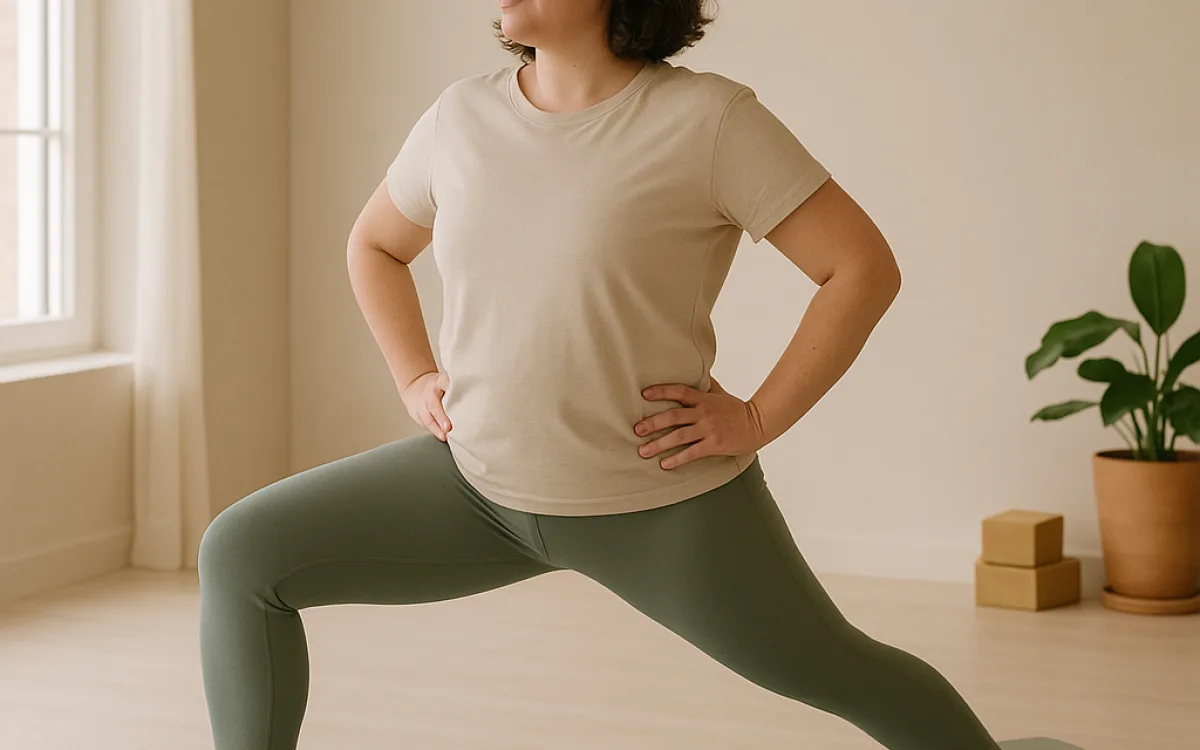
The warrior poses are where beginners build the leg and hip strength that makes every other standing pose possible. They are also where the most avoidable knee problems in yoga come from.
Everything that keeps them safe happens before you bend anything: it is in the feet.
Warrior II, the one to learn first#
Warrior II is the more forgiving of the two and appears more often in beginner classes. Set it up from the feet upwards.
- Step the feet wide, roughly a leg length apart. Wider is not better; you should feel stable, not stretched.
- Turn the front foot to point straight forward. Turn the back foot in about fifteen degrees, so the toes point slightly forward too.
- Line up the front heel roughly with the arch of the back foot.
- Bend the front knee towards the ankle, keeping it pointing in the same direction as the front foot.
- Reach the arms out to the sides at shoulder height, and look over the front hand. Shoulders down, not shrugged.
If holding the arms out is the hardest part of the pose, put your hands on your hips. The legs are the point; the arms are the decoration.
The knee rule, and why it matters more here than anywhere#
The front knee should point in the same direction as the front foot, throughout the pose. When the knee drifts inwards — which happens the moment the outer hip tires — the joint takes a twisting load it is not built for.
- Check by looking down: you should see your big toe on the inside of your knee, not hidden behind it.
- If the knee drifts in, straighten the leg slightly and shorten the stance. Depth is not worth the joint.
- Never let the knee travel past the ankle. Shin roughly vertical is the target.
- Press the outer edge of the back foot down. A collapsing back arch pulls the front knee inwards more than anything else does.
Knee pain during or after warrior poses is a set-up problem in almost every beginner case, not a sign that your knees are unsuitable for yoga.
Warrior I, and why it is harder than it looks#
Warrior I faces forward, with the hips squarer and the arms overhead. It asks for ankle, hip and shoulder mobility all at once, which is why beginners often find it less comfortable than warrior II despite it looking simpler.
| Warrior II | Warrior I | |
|---|---|---|
| Hips | Open to the side | Facing forward |
| Back foot | Turned in 15 degrees | Turned in 45 to 60 degrees |
| Arms | Out to the sides | Overhead |
| Main demand | Leg and hip strength | Ankle, hip flexor and shoulder mobility |
| Common problem | Front knee drifting in | Lower back arching, back heel lifting |
If squaring the hips forward in warrior I pulls your lower back into an arch, step the back foot wider to the side. Hips perfectly square is a goal for later, and for some hips never.
Building up safely#
- Start with a shorter stance and a shallower bend than feels impressive. Depth is the last thing to add.
- Hold for three to five breaths per side at first, and always do both sides for the same count.
- Add a wall behind you for the back foot if it keeps sliding.
- Use a block under the back heel in warrior I if it will not stay down, rather than forcing the ankle.
What the warriors are actually training#
These poses build strength in the quadriceps, glutes and outer hip, and they train the hip stability that protects the knees in daily life. They also build the capacity to hold an effortful shape while breathing calmly, which is the skill that transfers to everything else in a practice. That is why five honest breaths in a modest warrior II is worth more than a deep one held for two.
Frequently asked questions
Why do my knees hurt in warrior pose?
Nearly always because the front knee is drifting inwards, travelling past the ankle, or both. Look down: you should be able to see your big toe on the inside of the knee. If the knee is hiding it, shorten your stance and bend less deeply. The second common cause is the outer edge of the back foot lifting, which pulls the whole front leg inwards.
What is the difference between warrior I and warrior II?
Warrior II opens the hips to the side with the arms out wide, and is mainly a strength pose. Warrior I faces forward with the hips squarer and the arms overhead, and demands considerably more ankle, hip flexor and shoulder mobility. Beginners generally find warrior II more accessible, which is why most beginner classes teach it first.
How wide should my stance be in warrior pose?
About one leg length, but stability is the real test rather than the measurement. If you cannot press the outer edge of the back foot down, or the front knee will not stay over the ankle, the stance is too wide. A shorter stance with good alignment builds far more strength than a wide one you are fighting to hold.
warrior poses for beginnerswarrior 2 yogavirabhadrasana beginnerknee pain yoga warriorwarrior 1 vs warrior 2standing yoga poses