Basic Yoga Poses for Beginners: The Only Eight You Need
Almost every beginner class is built from the same small set of shapes. Learn eight of them properly and you stop watching the screen and start feeling the pose, which is where the practice actually begins.
Each one below has the same four parts: how to get in, the cue that matters most, the mistake nearly everyone makes, and the version to use if the full pose is not available today.
1. Mountain pose and 2. Child pose — the two resets#
These are the poses you return to, and the ones beginners skip because they look like nothing is happening. Both are doing a great deal.
- Mountain pose: stand with feet hip width, weight even across both feet, arms relaxed. The cue that matters: spread the toes and feel the outside edge of each foot. The common error is locking the knees hard back.
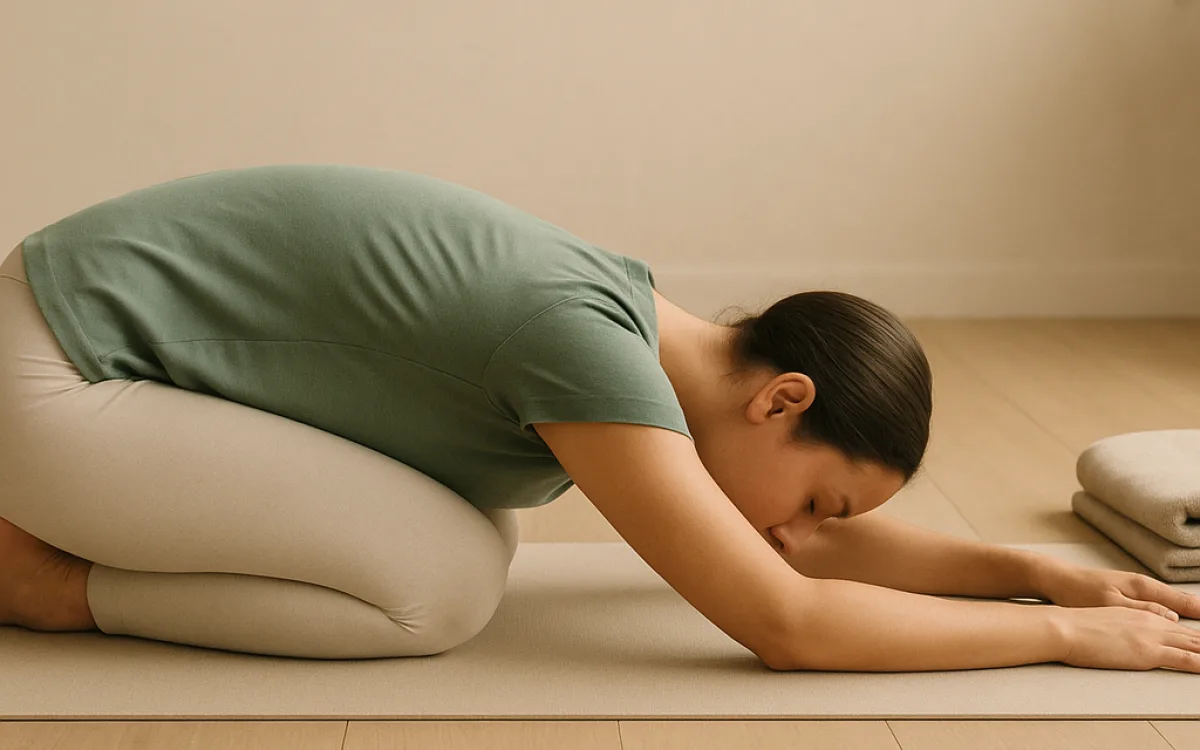
- Child pose: knees wide or together, hips towards the heels, forehead down, arms forward or alongside the body. The cue: let the belly soften between the thighs. The common error is forcing the hips down when the ankles or knees will not allow it.
- Easier child pose: a folded blanket behind the knees, or a cushion under the forehead and another between the heels and the hips.
Child pose is the universal opt-out in any class. Taking it is not giving up; it is the correct response to a pose that is not right for you today.
3. Cat-cow and 4. Downward dog — the spine and the shoulders#
Cat-cow teaches you to move the spine segment by segment, which is the skill every other pose depends on. Downward dog is the pose beginners hate and the one that changes fastest.
- Cat-cow: hands under shoulders, knees under hips. Inhale, let the belly drop and the chest lift; exhale, round the whole spine. The cue: move slowly enough that the movement travels from the tailbone to the neck rather than all at once.
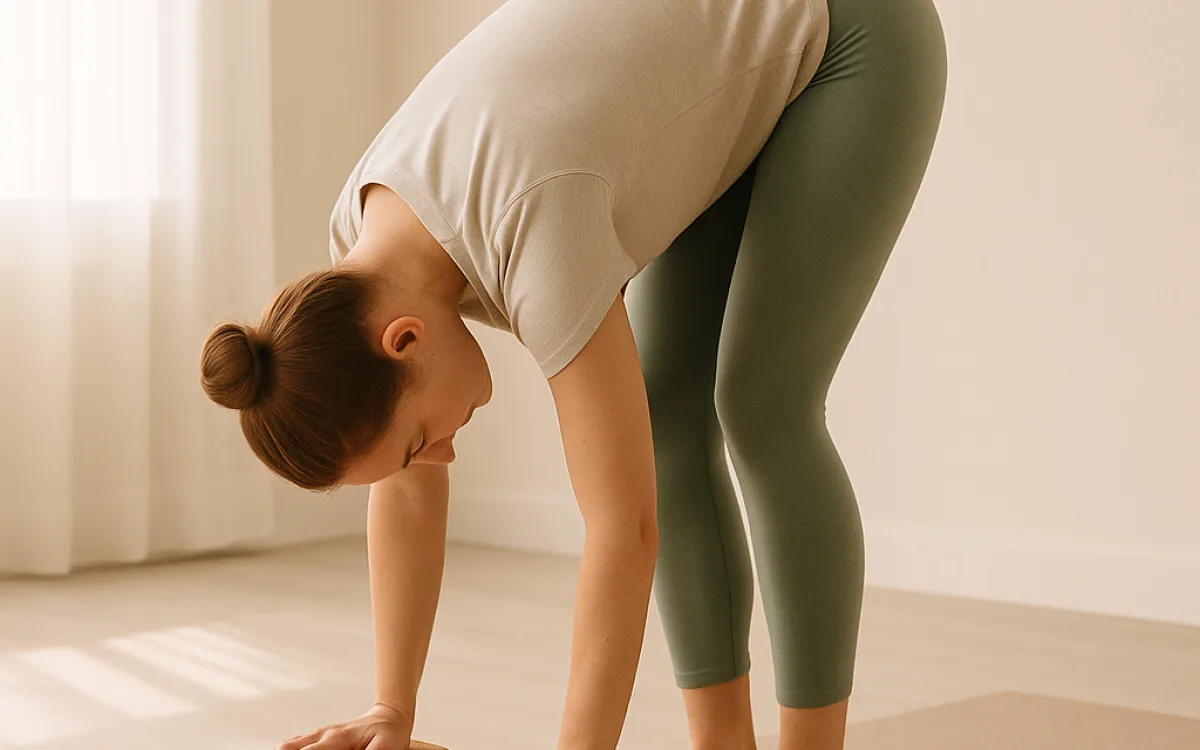
- Downward dog: from hands and knees, tuck the toes and lift the hips up and back into an inverted V. The cue: bend the knees generously and lift the sitting bones. The common error is chasing straight legs and heels down, which rounds the back and loads the wrists.
- Easier downward dog: knees clearly bent, heels lifted, hands on blocks. Or do it with hands on a wall or a chair seat, which keeps the shape and removes most of the weight.
In downward dog the weight belongs in the whole hand, not the heel of the palm. Spread the fingers wide and press the knuckle at the base of the index finger down.
5. Warrior II and 6. Triangle — the standing pair#
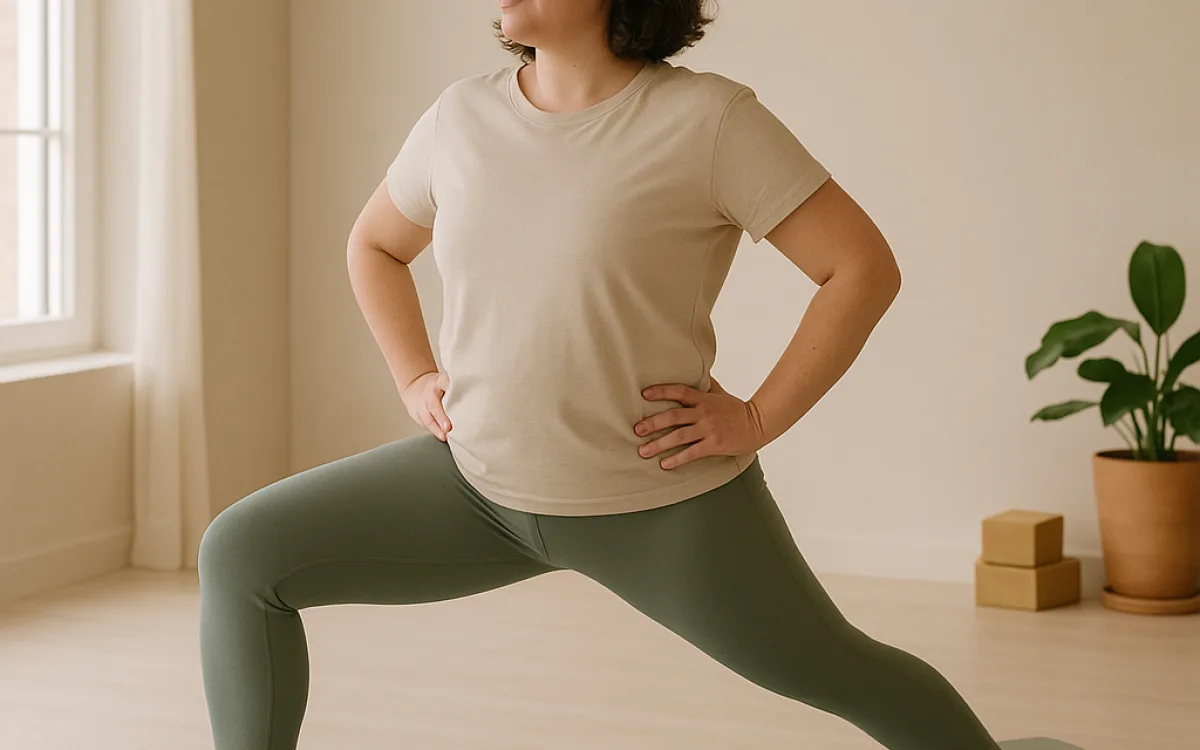
- Warrior II: feet wide, front foot forward, back foot turned in slightly, front knee bending towards the ankle, arms out to the sides. The cue: front knee tracks over the second toe. The common error is the knee collapsing inwards.
- Easier warrior II: shorten the stance and bend the front knee only slightly. Hands on the hips instead of arms out removes most of the shoulder fatigue.
- Triangle: from a wide stance, reach the front hand forward and then down to the shin or a block, top arm up. The cue: length along both sides of the waist, not depth. The common error is reaching for the floor and collapsing the lower side.
- Easier triangle: hand on a block at its tallest setting, or on the shin. Never on the knee joint itself.
7. Bridge and 8. Supine twist — the floor pair#
- Bridge: lying down, knees bent, feet hip width and close to the hips. Press the feet down and lift the hips. The cue: press through the heels and keep the knees pointing forward. The common error is squeezing the glutes hard and driving the hips so high the lower back complains.
- Easier bridge: place a block flat under the sacrum and rest on it. This is the supported version and is arguably better for a stiff lower back than the active one.
- Supine twist: lying down, draw both knees in, then let them drop to one side with the arms out wide. The cue: let the opposite shoulder stay heavy. The common error is forcing the knees to the floor while the shoulder lifts.
- Easier supine twist: a cushion under the knees where they land, so nothing has to be held.
How to practise these eight#
Repetition is what turns a pose you can copy into a pose you can feel. Learning all eight in one session is possible; learning them properly takes a few weeks.
- Week 1: mountain, child, cat-cow, downward dog. Ten minutes, three times.
- Week 2: add warrior II and triangle on both sides.
- Week 3: add bridge and supine twist at the end as a wind-down.
- Week 4: string all eight into one fifteen-minute sequence and repeat it until it is boring.
- Only when it is boring are you ready to add anything new — boredom means your attention is free for the details.
Frequently asked questions
What are the most important yoga poses for a beginner?
Child pose, cat-cow, downward dog and mountain pose, in that order of usefulness. Child pose and cat-cow are the safest and give the most immediate relief to a stiff back. Downward dog appears in almost every class, so learning it properly early saves months of sore wrists. Mountain pose looks like standing still and teaches the weight distribution that every standing pose depends on.
How long should I hold each pose?
Five slow breaths is the standard beginner hold, which is roughly thirty seconds. That is long enough for the supporting muscles to engage and short enough that your form does not fall apart. In restful poses such as child pose or a supported bridge, one to three minutes is fine. If your breathing becomes uneven, come out — that is the signal, not the clock.
Do I need to do poses on both sides?
Yes, and it is the most commonly skipped detail in home practice. Any pose with a front leg, a top arm or a twisting direction should be done on both sides for roughly the same length of time. Most people are noticeably more comfortable on one side; the instinct is to spend longer on the easier side, which slowly widens the gap.
basic yoga poses for beginnersbeginner yoga posesyoga poses listchild posedownward dog beginnerwarrior 2 pose